Investing in the Future: Building Smart Manufacturing Through Connected Data
To stay ahead of the curve, we know we need to be constantly looking at ways to utilise advanced technologies, automation and systems that directly benefit our customers. This requires forward thinking and investment, something we do consistently across the business.
We’re already making strong progress on our Industry 4.0 journey, introducing smart manufacturing equipment across the site to create a more connected production environment. However, we also recognise that innovation doesn’t just come from new investment, it comes from improving and better connecting what we already have. Access to live data is a key part of this, enabling real-time performance reporting and giving us the flexibility to scale our systems as the business grows.
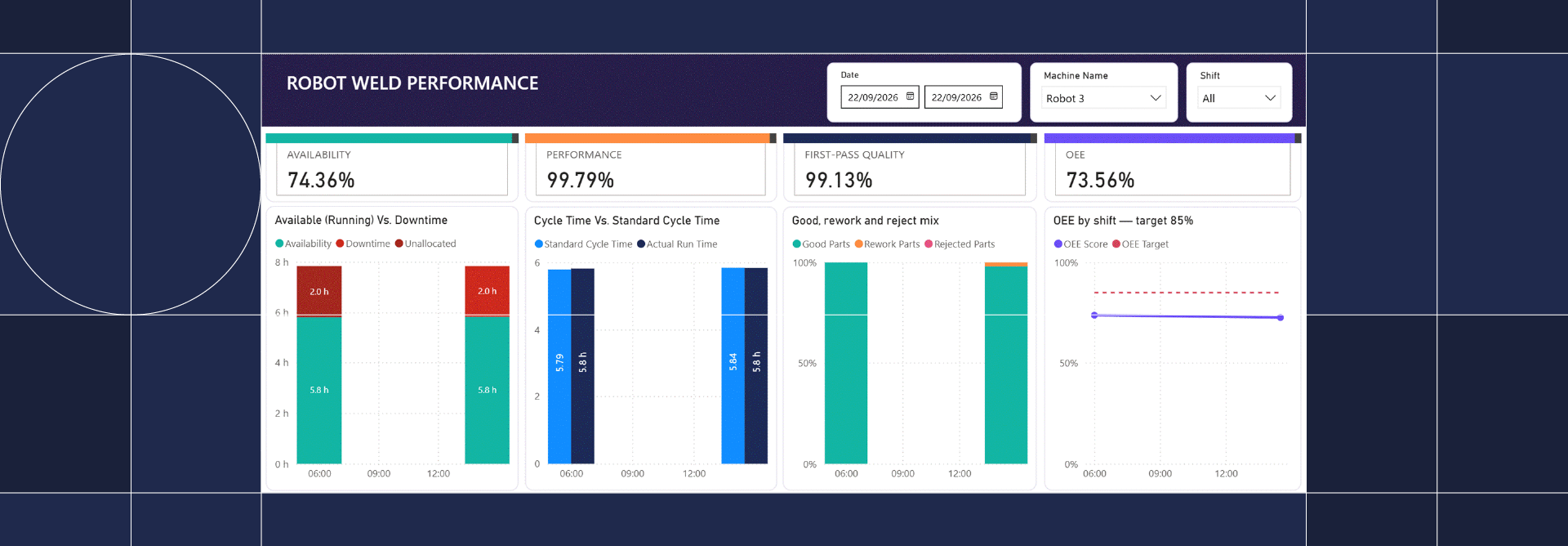
Therefore, over the years we have developed several of our own internal systems to support production, shop floor data collection and manufacturing control. The latest stage of that work has been to connect those systems more closely with live machine data, giving us a much clearer picture of what is happening on the shop floor. This has led to the development of our own OEE (Overall Equipment Effectiveness) and machine monitoring system.
Lee Bailey, Software & Systems Engineer at Hydram talks us through the project so far and where it is heading.
Rather than introduce a standalone, off-the-shelf OEE package, we have taken our existing production systems, added real-time machine monitoring and built the reporting and logic around the way Hydram works.
In many ways, it is an extension of what we already do, but bringing the two sides together creates something completely new.
Real-Time Data in Robotic Welding
The first stage of the project has been introduced within our robotic welding section.
Each welding robot has been fitted with advanced monitoring equipment that allows us to capture electrical activity and machine behaviour in real time. This tells us when a machine is running, idle or stopped. But the real value comes from linking that data back into our existing production systems.
By combining machine activity with information such as jobs, operations, cycle times, quantities, operators and shift data, we can start to understand not just whether a machine is running, but what it is doing and how effectively it is performing.
From there, we can build a complete OEE picture around:
- • Availability – how much of the available production time the machine is running
- • Performance – how the real machine run time compares with the standard time for the work completed
- • Quality – how much of the production is completed without reject or rework
This gives us a much more reliable view than looking at machine data or operator input in isolation. Having this information will enable us to monitor machine uptime to ensure production stays on schedule, validate product cycle times for accurate project quoting and planning and identify operational bottlenecks, before they cause delays.
Combining Machine Data with Operator Knowledge
Automation gives us the facts around machine activity, but it cannot always tell us why something happened. That is where operator input remains important.
Our operators are undergoing tailored OEE training to combine their hands-on expertise with our new digital tools.
During each shift, operators will log downtime reasons, track output performance against plans and record the exact number of right-first-time parts.
For instance, if a machine stops the monitoring can identify the loss of running time, while downtime recording can give us the reason behind it.
By merging automated machine metrics with operator insights, we gain a comprehensive, transparent view of our shop floor performance. This gives our production and engineering teams better information to work with and helps remove some of the guesswork from performance analysis.
Benefitting From Connected Data
The point of the project is not to collect more data for the sake of it. The aim is to make the information useful and applicable.
The system is being developed to give us both live and historical visibility of areas such as machine utilisation, cycle time performance, downtime, production losses and recurring issues.
That can help us:
- • Better understand machine availability and utilisation
- • Validate real manufacturing cycle times
- • Identify repeated downtime and bottlenecks
- • Compare actual performance against our existing standards
- • Improve the information available for planning and quoting
- • Support future process and equipment investment
It also gives us a much stronger basis for continuous improvement, because we are working from actual production data rather than assumptions.
We already capture a significant amount of production information through our internal shop floor systems. The new monitoring layer, that has been developed around our own systems and processes, adds live machine behaviour to that data. This is where the real value is.
We are taking systems we already know and trust, adding new technology where it helps, and building something that is specific to how we manufacture.
Developing Smart Manufacturing for World-Class Operational Standards
Robotic welding is the first area where the system is being developed and proven, but it has been designed with wider use in mind.
Future phases of our digital manufacturing programme will see OEE systems adapted and integrated across all Hydram disciplines, including:
- • Laser cutting and punching
- • CNC machining
- • Press brakes
- • Automated paint systems
- • Other automated and semi-automated manufacturing equipment
Ultimately, this project is about having a better understanding of what is really happening in production. To achieve that our aim is to create a flexible platform that can grow as we learn and as new requirements emerge.
By joining machine data, production information and operator knowledge together, we can build a much clearer picture of how our equipment and processes are performing.
That information can then be used to drive operational efficiencies, improve performance and help move our robotic welding operations towards world-class OEE standards, while giving us better information to support future investment decisions.
The robotic welding system is only the first stage, but it provides a strong foundation for the wider use of connected manufacturing data across the company.
For us, that is what smart manufacturing should be about: making better use of the systems and knowledge we already have, adding the right technology where it brings value, and using the result to make better decisions.
If you’d like to know more about the investments we’re making and our capabilities, get in touch with our team.
Back to Articles