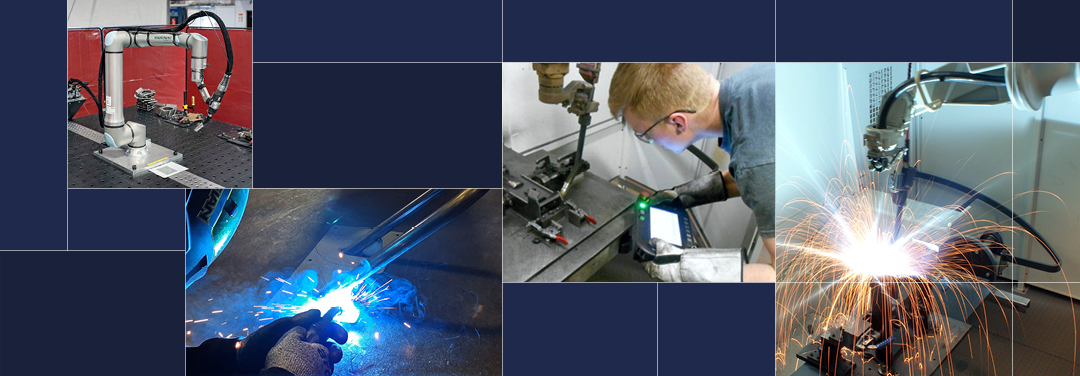
Man Vs Machine: Addressing Various Welding Strategies
As a complete manufacturing partner, we’re able to deliver both manual and automated welding capabilities from our state-of-the-art facility in County Durham. And therefore, know where and when to apply the precision of automated welding with the expertise of manual welding of complex fabrications.
If we first look at manual welding, it’s a well-established discipline that delivers versatility, adaptability and strict quality control.
A welder has to control and set up the welding parameters on the welding machine to the required procedure specifications. This learned experience isn’t easy to apply and requires educated skill, especially when dealing with changeable and complex welds. A skilled welder can adjust technique, speed and make corrections in real-time by continually making quality observations during the process (often by ear alone) and adapting as necessary.
Therefore, manual welding is often best suited to small batches, prototypes or one-off products where complex geometries and specialised materials require the spatial awareness and problem-solving skills of an experienced welder, who can make appropriate judgements on the weld process.
With our team of skilled MAG and TIG welders and dedicated welding bays, we can be ready to start a project quickly with our expertise to know which equipment will be required to ensure a successful outcome.
In addition, we hold a wealth of certifications which ensure our weld projects can be trusted for quality and safety in critical applications, such as:
- • ISO 3834-2:2005 – Defines comprehensive quality requirements for fusion welding of metallic materials both in workshops and at field installation sites.
- • BS EN 15085-2 CL 1 – Demonstrates our competence for control of welding quality in the production of railway vehicles and components.
- • ECWRV – Demonstrates our competence for control of welding quality in the production of railway vehicles and components for European products
- • DIN 2303 – Demonstrates qualification for the manufacture of military products by welding.
Furthermore, all welding procedures and our welder qualifications are carried out by a third party in accordance with ISO 15614 and ISO 9606 and are Lloyds approved.
All of this being said, and in addition to our highly skilled welding team, we have two automatic Panasonic MAG welding robots and most recently have installed a welding cobot.
Both robot cells are equipped with automated turntables allowing maximum productivity. They have rotary manipulators allowing workpieces to be turned independently of the robot position.
These machines enable us to deliver precise accuracy at speed and are best suited to repetitive, high-volume work where we can maximise efficiency and guarantee uniformity across long production runs.
With the maximum welding robot capacity for components as 150kg and 2200mm long for metal fabrication and welding, they are ideal for the manufacture of automotive frames, agricultural parts and structural frames.
Whilst our cobot welding bridges the gap between manual precision and full industrial automation, offering a highly flexible, safe, and cost-effective solution for our fabrication shop. Unlike traditional industrial robots that require massive safety cages and complex programming, collaborative robots (cobots) are designed to work directly alongside human operators.
However, the strongest point of our automated welding capabilities is that they enable us to deliver a hybrid workflow. Which means that we can ensure structural integrity is maintained where strength is critical, cosmetic areas are finished cleanly and production remains highly cost-effective.
You can never wholly replace the ‘irreplaceable’ human skill of welding but combining rich experience with the automation of robots and working in collaboration with cobots can undoubtedly save time and resources – freeing assets and people to be used elsewhere to better meet the demands of our busy fabrication facility, such as on more complex weld projects or quality inspection.
By balancing automated capacity with manual expertise, we support the consolidation of supply chains, simplify supplier management and accelerate time-to-market.
From initial profile cutting through to fabrication and final powder coating and assembly, we can manage the entire subcontract process under one roof.
Contact our technical engineering team to discuss your next project.
Back to Articles